Marketing has always been about one fundamental question:
When a potential customer needs something you sell, will they find you, trust you, and ultimately choose you?
For years, the answer revolved around Google rankings, social media followers, advertising and email marketing.
That world is changing.
In 2026, customers are increasingly discovering businesses through a combination of traditional search, AI-generated answers, social content, recommendations, reviews, communities and paid media. Instead of simply asking Google for ten blue links, people can ask ChatGPT, Gemini, Perplexity or AI-powered search interfaces to research a problem, compare alternatives and recommend what they should buy.
This changes the definition of visibility.
A business no longer needs to be merely ranked.
It needs to be discoverable, understandable, credible, memorable and recommendable across multiple digital environments.
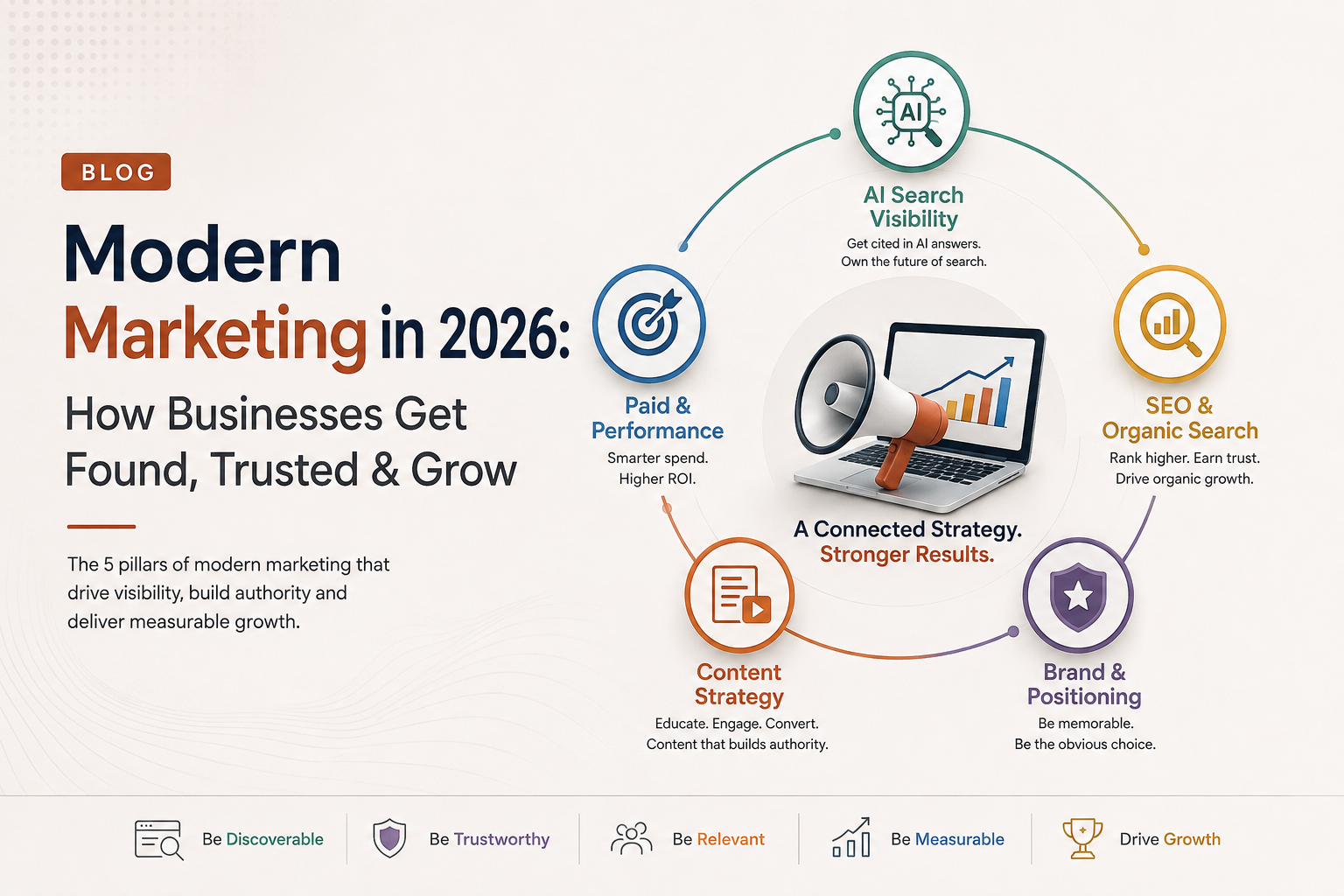
The framework in the accompanying image captures this shift through five interconnected pillars:
- AI Search Visibility
- SEO & Organic Search
- Brand & Positioning
- Content Strategy
- Paid & Performance
Together, they form a modern marketing ecosystem.
1. The Biggest Change: Search Is Becoming an Answer
Traditional search was largely a ranking game.
A customer searched for:
“Best accounting software for small businesses”
Google returned a collection of websites.
The marketer’s objective was straightforward:
Get into the top results.
AI-powered search changes the interaction.
A customer might now ask:
“What accounting software would you recommend for a 20-person manufacturing company in India?”
Instead of receiving ten links, the user may receive a synthesized answer containing recommendations, comparisons and sources.
That means a company can potentially influence the customer’s decision without receiving the first click.
This is why AI Search Visibility has become an important new layer of digital marketing. Industry research in 2026 increasingly describes AEO and GEO as complementary to traditional SEO rather than simple replacements for it.
The implication is profound:
Your website is no longer the only place where your brand makes its first impression.
An AI assistant can make that first impression for you.
2. Pillar One: AI Search Visibility
The first branch in the framework is AI Search Visibility.
It contains five important activities:
- AI citations — AEO/GEO
- Query fanout mapping
- Schema and technical setup
- Share-of-voice tracking
- Monitoring ChatGPT, Perplexity and Gemini
Let’s examine why each matters.
AI Citations: Becoming Part of the Answer
In traditional SEO, you want Google to rank your page.
In AI search, you increasingly want your brand or content to become a source that an AI system can rely upon.
This is the fundamental difference between:
“Can I rank?”
and
“Can I become a source?”
For example, imagine a company selling industrial packaging.
A traditional SEO strategy might target:
industrial packaging manufacturer India
An AI visibility strategy goes deeper.
It asks:
- Who are the leading industrial packaging manufacturers?
- What packaging is best for exporting fragile products?
- What should companies consider when selecting packaging suppliers?
- Which packaging materials are recyclable?
- How much does industrial packaging typically cost?
- Which suppliers serve particular industries?
The goal is to create a comprehensive information ecosystem around the company’s expertise.
Query Fanout Mapping
One of the most important concepts in AI search is query fanout.
A customer may ask one broad question, while the underlying system explores multiple related questions before constructing its answer.
For example:
“What’s the best CRM for my company?”
That could involve hidden sub-questions such as:
- What size is the company?
- What industry is it in?
- What features are important?
- Does it need WhatsApp integration?
- What is the budget?
- Which platforms integrate with existing software?
- What are the implementation difficulties?
- What do users say about each product?
Therefore, optimizing for one keyword is insufficient.
Modern marketers need to understand the question ecosystem surrounding a topic.
This leads to a useful principle:
Don’t optimize for keywords. Build authority around decisions.
Schema and Technical Setup
AI visibility isn’t purely about writing content.
Machines also need to understand what your business actually is.
That makes structured data, clean information architecture, entity relationships, crawlability, product information and consistent business details increasingly important.
A company’s website should make it easy for machines to understand:
- Who you are
- What you sell
- Where you operate
- Who you serve
- What makes you different
- Which products or services you offer
- Who the people behind the company are
- What evidence supports your claims
The objective is simple:
Reduce ambiguity.
A clearly structured business is easier for both humans and machines to understand.
3. Share of Voice Is Moving Beyond Google
Traditional marketing reports often focus on:
- Keyword rankings
- Organic traffic
- Impressions
- Click-through rate
- Conversion rate
Those metrics remain important.
But AI search introduces another question:
How often does my brand appear when customers ask relevant questions?
This creates the idea of AI Share of Voice.
For example, imagine customers ask 100 commercially relevant questions across ChatGPT, Gemini and Perplexity.
Your brand appears in 38 answers.
Your competitor appears in 62.
You may have excellent SEO performance, yet your competitor owns more of the AI recommendation space.
This is why modern marketing measurement increasingly includes citation frequency, AI visibility and competitive share of voice.
The KPI is evolving from:
“Where do we rank?”
toward:
“How frequently are we present when important decisions are being discussed?”
4. Pillar Two: SEO & Organic Search
The rise of AI does not make SEO irrelevant.
Quite the opposite.
SEO remains the foundation.
The framework identifies five components:
- Keyword and fanout research
- On-page optimisation
- Technical SEO
- Backlinks and authority
- Content indexing
The mistake is assuming that GEO replaces SEO.
It doesn’t.
A better way to think about it is:
SEO creates discoverability.
AEO creates answerability.
GEO creates AI visibility.
The underlying foundation is still quality information that search systems can discover, understand and trust.
Keyword Research Is Becoming Question Research
Traditional keyword research asks:
“What keywords have search volume?”
Modern research should also ask:
“What questions does my customer ask before, during and after buying?”
Consider a consumer purchasing a premium food product.
The journey might look like:
Awareness
“What is makhana?”
Education
“Is makhana healthy?”
Comparison
“Makhana vs popcorn — which is better?”
Product research
“Best roasted makhana brands”
Commercial intent
“Buy roasted makhana online”
Post-purchase
“How should roasted makhana be stored?”
Each question represents a different opportunity.
A sophisticated content strategy covers the entire decision journey, not simply high-volume keywords.
5. Technical SEO Still Matters
The most creative content in the world cannot compensate for a technically broken website.
Technical SEO includes:
- Crawlability
- Indexation
- Site architecture
- Page speed
- Mobile experience
- Internal linking
- Canonicalisation
- Structured data
- Duplicate-content management
- XML sitemaps
- JavaScript rendering
- Image optimisation
The goal isn’t to “do technical SEO because Google says so.”
The goal is to make the website an efficient information system.
If search engines and AI systems cannot reliably access, interpret and connect your information, your content has limited value.
6. Authority Is Still a Competitive Advantage
The image also highlights backlinks and authority.
This matters because visibility is not only about what your company says about itself.
It is also about what the rest of the internet says about you.
Think about two companies.
Company A says:
“We are India’s leading expert.”
Company B is mentioned by:
- Industry publications
- Relevant associations
- Customers
- Journalists
- Experts
- Partners
- Review platforms
- Educational resources
Which company appears more credible?
The second.
This is why digital authority increasingly extends beyond backlinks.
It includes the entire reputation footprint of the business.
7. Pillar Three: Brand & Positioning
This is arguably the most underestimated part of modern digital marketing.
AI may help people discover you.
SEO may help them find you.
Content may educate them.
Paid advertising may bring them back.
But brand positioning gives them a reason to remember you.
The framework identifies five elements:
- Positioning and differentiation
- Brand voice and tone
- Visual identity
- Reputation management
- Trust and authority signals
8. Differentiation Is Becoming More Important in an AI World
AI can generate endless content.
That creates a problem.
If every company publishes:
“10 Tips for Better Marketing”
the internet becomes saturated with interchangeable information.
AI makes content production easier.
Therefore, generic content becomes less valuable.
The brands that stand out need stronger intellectual and commercial positioning.
Instead of:
“We provide digital marketing services.”
A stronger position might be:
“We help B2B manufacturers turn technical expertise into a predictable inbound pipeline.”
The second statement is more specific.
Specificity creates differentiation.
9. Brand Voice Matters
AI can generate grammatically perfect content.
But perfect grammar isn’t a brand.
A memorable brand has recognizable characteristics.
It might be:
- Analytical
- Bold
- Practical
- Humorous
- Premium
- Contrarian
- Educational
- Conversational
A strong brand voice makes content recognizable even when the logo isn’t visible.
This becomes especially important when competitors have access to the same AI tools.
If everyone can generate content at the same speed, voice becomes a competitive asset.
10. Visual Identity Is Not Decoration
Visual identity is often treated as a design exercise.
It should instead be treated as a recognition system.
Customers should be able to associate certain:
- Colours
- Typography
- Photography
- Illustrations
- Layouts
- Icons
- Packaging
- Design patterns
with your company.
A strong visual identity reduces the amount of cognitive effort required to recognize a brand.
In a crowded digital environment, that matters.
11. Reputation Management Becomes More Important With AI
There is another reason brand reputation matters in 2026.
AI systems can synthesize information from across the web.
That means inaccurate, outdated or contradictory information about a business can become a visibility problem.
Imagine your website says one thing.
A directory says something else.
An old article contains outdated pricing.
A review platform contains incorrect information.
A social profile hasn’t been updated in three years.
Individually, these may look insignificant.
Collectively, they create an inconsistent digital identity.
Modern reputation management therefore isn’t simply about responding to negative reviews.
It is about maintaining a consistent and trustworthy digital footprint.
12. Pillar Four: Content Strategy
The image identifies five content priorities:
- Founder-led content
- Educational posts and guides
- Lead magnets and playbooks
- Video and short-form content
- Repurposing across channels
This represents another major shift.
Content should no longer be created simply because “we need to post something today.”
It should have a strategic job.
13. Founder-Led Content
One of the strongest forms of content is original thinking from people who actually understand the industry.
Founders and subject-matter experts can provide:
- Opinions
- Experiences
- Lessons
- Predictions
- Mistakes
- Case studies
- Frameworks
- Contrarian perspectives
This is difficult for competitors to copy.
AI can imitate writing style.
It cannot easily reproduce your actual experiences.
That is why founder-led content can create an important moat.
A founder saying:
“We lost our biggest customer because we made this mistake…”
is dramatically more valuable than another generic article titled:
“5 Ways to Improve Customer Retention.”
The first contains experience.
The second contains information.
Modern audiences increasingly need both.
14. Educational Content Builds Trust Before the Sale
A customer rarely wakes up ready to buy.
They first need to understand the problem.
Then they explore solutions.
Then they compare alternatives.
Then they evaluate vendors.
Educational content should support every stage.
For example:
Beginner content
“What is performance marketing?”
Intermediate content
“How much should a startup spend on Google Ads?”
Advanced content
“How to calculate CAC payback period”
Decision content
“Google Ads vs LinkedIn Ads for B2B companies”
Vendor content
“How our agency approaches B2B lead generation”
This progression turns content into a sales education system.
15. Lead Magnets Turn Attention Into Assets
Content generates attention.
Lead magnets create an exchange.
Examples include:
- Checklists
- Templates
- Calculators
- Industry reports
- Playbooks
- Benchmark reports
- Audits
- Guides
- Research studies
The principle is:
Give something genuinely useful in exchange for permission to continue the relationship.
This is particularly important because social reach and search visibility are rented attention.
Email lists, CRM relationships and first-party customer data are owned assets.
16. Video and Short-Form Content
People don’t consume information in one format.
A single strong idea can become:
- LinkedIn post
- Instagram Reel
- YouTube Short
- Long-form YouTube video
- Blog article
- Carousel
- Newsletter
- Podcast discussion
- Sales presentation
This leads to a critical concept in the framework:
Repurposing across channels.
Instead of asking:
“What should we post today?”
ask:
“What valuable idea can we distribute in ten different formats?”
That shift dramatically improves content efficiency.
17. Pillar Five: Paid & Performance
Organic visibility takes time.
Paid media provides speed.
The framework includes:
- Paid social
- Google Ads and PPC
- Retargeting
- CAC and ROAS tracking
- Funnel and attribution setup
The strongest marketing organizations do not treat paid and organic as competitors.
They use them together.
18. Paid Social Is More Than Advertising
Platforms such as Meta and LinkedIn can be used for different purposes.
Awareness
Introduce the brand.
Education
Explain a problem.
Consideration
Show proof and differentiation.
Conversion
Drive a specific action.
Retargeting
Reconnect with people who already showed interest.
The mistake is using every campaign for immediate conversion.
Not every customer is ready to buy.
Marketing should meet customers at different stages of intent.
19. Google Ads Captures Existing Demand
Paid search is particularly powerful because the customer is already expressing intent.
Someone searching:
“CRM software for manufacturing”
is fundamentally different from someone passively scrolling through Instagram.
Paid search therefore works especially well when:
- Demand already exists
- Keywords have commercial intent
- The product has clear economics
- Landing pages are strong
- Conversion tracking is reliable
But traffic alone isn’t the goal.
The real question is:
How much profitable revenue does each acquisition channel generate?
20. Retargeting Connects the Journey
Very few people buy after their first interaction.
Someone may:
- See your video.
- Visit your website.
- Read an article.
- Leave.
- Search your brand.
- Read reviews.
- Return two weeks later.
- Download a guide.
- Talk to sales.
- Finally purchase.
Retargeting helps maintain continuity throughout this journey.
But good retargeting is not simply showing the same advertisement repeatedly.
The message should evolve.
First interaction:
“Discover the problem.”
Second interaction:
“Here is how to solve it.”
Third interaction:
“Here is why customers choose us.”
Final interaction:
“Ready to get started?”
21. CAC and ROAS: The Numbers Behind Marketing
Creative marketing means little if the economics don’t work.
Two metrics are particularly important.
Customer Acquisition Cost — CAC
How much does it cost to acquire a customer?
If you spend ₹1,00,000 and acquire 20 customers:
CAC = ₹5,000
But CAC should not be evaluated in isolation.
You need to compare it with:
- Average order value
- Gross margin
- Customer lifetime value
- Repeat purchase rate
- Payback period
A ₹5,000 CAC may be excellent for a customer worth ₹1 lakh.
It may be terrible for a customer worth ₹3,000.
22. ROAS Is Useful — But Not Enough
ROAS measures revenue generated relative to advertising spend.
For example:
₹2,00,000 advertising spend
₹8,00,000 attributed revenue
ROAS = 4X
But revenue isn’t profit.
A campaign can show strong ROAS while producing poor margins.
Modern performance marketing should therefore connect advertising data to business economics.
The ultimate question is not:
“Did the ad generate revenue?”
It is:
“Did the marketing generate profitable growth?”
23. Funnel and Attribution Setup
This is where all five pillars connect.
Imagine a customer:
- Discovers your brand through an AI answer.
- Searches Google.
- Reads your website.
- Watches a LinkedIn video.
- Clicks a retargeting ad.
- Downloads a guide.
- Receives an email.
- Books a meeting.
- Becomes a customer.
Which channel deserves credit?
All of them influenced the journey.
This is why attribution is difficult.
Modern marketing teams need to understand the difference between:
last-click attribution
and
full customer journey attribution.
The first interaction may create awareness.
The middle interactions may create trust.
The final interaction may create conversion.
Giving all credit to the final click can result in poor budget decisions.
24. The Five Pillars Are Actually One System
The most important insight from the image is not the five categories.
It is the connections between them.
Consider this flywheel:
Brand → Content → SEO → AI Visibility → Paid Distribution → Data → Better Content → Stronger Brand
Each component reinforces the next.
A strong brand creates better content.
Better content improves organic visibility.
Organic authority can support AI visibility.
AI visibility creates additional discovery.
Paid campaigns amplify winning messages.
Performance data reveals what customers respond to.
Those insights improve future content.
The cycle repeats.
25. The New Marketing Funnel Is Not Linear
The traditional funnel looked like:
Awareness → Consideration → Conversion
The 2026 customer journey is more like a network.
A customer might discover you through:
- ChatGPT
- YouTube
- A review
- A podcast
- A friend
- An advertisement
Then jump between channels.
This means companies should stop thinking exclusively in terms of campaigns.
They should start thinking in terms of customer journeys and digital ecosystems.
26. What Businesses Should Measure in 2026
A modern marketing dashboard should go beyond traffic and followers.
AI Visibility
- AI mentions
- AI citations
- Citation quality
- Share of AI voice
- Competitor visibility
- Query coverage
- Brand accuracy in AI answers
Organic Search
- Rankings
- Organic traffic
- Indexed pages
- Non-brand visibility
- Backlinks
- Organic conversions
Brand
- Branded search volume
- Direct traffic
- Review sentiment
- Brand mentions
- Share of voice
- Customer trust indicators
Content
- Engagement
- Saves
- Shares
- Qualified traffic
- Leads generated
- Content-assisted conversions
Paid
- CAC
- ROAS
- CPL
- Conversion rate
- Customer lifetime value
- Payback period
The key is not to measure everything.
It is to measure the indicators that connect marketing activity to business outcomes.
27. What Small and Mid-Sized Businesses Should Do First
Not every business needs an enormous marketing department.
The better approach is to build the foundation sequentially.
Phase 1: Fix the Foundation
Start with:
- Website
- Technical SEO
- Business information
- Brand positioning
- Analytics
- Conversion tracking
Without this foundation, additional traffic may simply create more leakage.
Phase 2: Build Authority
Create:
- Educational content
- Customer stories
- Founder insights
- Expert guides
- Reviews
- Industry mentions
- Relevant backlinks
The objective is to make the company credible.
Phase 3: Build AI Visibility
Identify the questions customers ask AI tools.
Then track:
- Whether your brand appears
- What competitors appear
- Which sources are cited
- What information is missing
- Whether the AI description of your company is accurate
Do not treat GEO as a collection of tricks.
Treat it as digital authority management for AI-mediated discovery.
Phase 4: Add Distribution
Once you have strong messages and content:
Use:
- Meta
- Google Ads
- YouTube
- Retargeting
to distribute your best ideas.
Don’t create separate strategies for every channel.
Create one strong idea and distribute it intelligently.
Phase 5: Optimize the Economics
Finally, connect everything to:
- Leads
- Customers
- Revenue
- Gross margin
- CAC
- LTV
- Retention
Marketing becomes a growth engine when it can answer:
What did we spend, what did we create, what did we influence, and what did the business gain?
28. The Biggest Mistake in 2026
The biggest mistake isn’t ignoring AI.
It is treating AI as an isolated marketing tactic.
Adding “GEO” to your marketing checklist will not automatically make your company visible in AI answers.
If your positioning is weak, AI visibility will be weak.
If your website is technically poor, AI visibility will suffer.
If your content is generic, there is little reason for AI systems or humans to prefer it.
If nobody talks about your brand outside your own website, authority becomes harder to establish.
If your paid campaigns don’t have tracking, you won’t know whether growth is profitable.
Therefore:
AI visibility is an extension of a strong marketing foundation — not a replacement for one.
29. The Real Competitive Advantage
The companies that win in modern marketing will not necessarily be the companies that publish the most content.
They will be the companies that build the strongest information and trust ecosystem.
They will be:
- Easy for search engines to understand.
- Easy for AI systems to cite.
- Easy for customers to remember.
- Easy for prospects to trust.
- Easy for sales teams to explain.
- Easy for advertising platforms to target.
- Easy for customers to recommend.
That is a much bigger ambition than SEO.
It is digital discoverability by design.
30. The 2026 Marketing Equation
The framework can ultimately be reduced to one simple equation:
Visibility × Trust × Relevance × Distribution × Conversion = Growth
Where:
Visibility comes from SEO and AI search.
Trust comes from brand, reputation, authority and proof.
Relevance comes from positioning and customer-focused content.
Distribution comes from organic, social and paid channels.
Conversion comes from strong offers, landing pages, funnels and sales processes.
If any one of these is weak, the entire system becomes less efficient.
A company with huge visibility but low trust wastes traffic.
A company with great content but poor distribution remains unknown.
A company with excellent advertising but weak positioning becomes expensive to acquire.
A company with strong demand but poor conversion leaks revenue.
The goal is therefore not to become “good at marketing.”
The goal is to build a connected growth system.
Conclusion: Marketing in 2026 Is About Being the Brand People and Machines Choose
The modern customer journey is becoming increasingly complex.
People still search Google.
They also ask AI assistants.
They consume short-form videos.
They read reviews.
They compare brands.
They ask communities.
They see advertisements.
They talk to salespeople.
And increasingly, AI systems may help them evaluate those choices.
This creates a new definition of marketing success.
It is no longer enough to ask:
“Are we ranking?”
Instead, businesses should ask:
“Are we visible wherever our customers are making decisions?”
Are we appearing in search?
Are we appearing in AI answers?
Are we being mentioned by credible third parties?
Is our brand differentiated?
Are our experts creating original ideas?
Are our content assets educating customers?
Are our paid campaigns amplifying what works?
Are we measuring acquisition economics?
And most importantly:
When a customer asks, “Who should I choose?” — are we one of the brands that comes to mind?
That is the real opportunity behind modern marketing.
The future doesn’t belong to businesses that simply produce more content or spend more on ads.
It belongs to businesses that build authority, visibility, relevance and trust across the entire digital ecosystem.
SEO gets you discovered.
Content gets you understood.
Brand makes you remembered.
AI visibility gets you recommended.
Performance marketing accelerates the journey.
Together, they create the modern growth engine.
*Note: The AI-search portion of this framework reflects a rapidly evolving 2026 landscape. Current industry research supports treating AEO/GEO as complementary to SEO, while measurement standards and terminology are still developing. *